In this article
- What changed inside newer appliances?
- What does a control board failure look like?
- Why can a control board cost more than a mechanical part?
- Do energy-efficient appliances fail more often?
- Why do parts take longer to get?
- What did Canada's 2024 right-to-repair change do?
- Where the electronics show up in each appliance
- Simple care that protects newer appliances
- When does a repair still make sense?
- Not sure if it's worth fixing?
- FAQ
Newer fridges, washers, dishwashers and dryers do more than older models, and much of that work now runs through electronics: control boards, sensors and touch displays. More electronic parts means more things that can fail, and one failed board can stop the whole machine even when the motor, pump and drum are fine. Parts supply matters too, because a repair can only move as fast as the part arrives.
Repair technicians notice the change. In a survey of 38 appliance technicians by Environment America and PIRG, refrigerators, washing machines and dryers were the appliances they most often named as having the biggest drops in lifespan (Environment America). Here is what changed, what a board failure looks like, and what it means for your next repair.
Have a newer appliance acting up? Call 1-855-448-0096 or book a diagnostic online.
What changed inside newer appliances?
Older, simpler appliances often ran for many years with few repairs. A timer, a few switches and a motor did the work, and a technician could test each part with a meter.
Today the same jobs run through circuit boards. Where an appliance from a decade ago might have had one board, many newer models, especially smart ones, have a control board for each major system (repair coalition letter to the FTC, PIRG). That makes them more convenient to use, but it also makes them more complex to diagnose and repair.
The technicians in the Environment America survey pointed to three main reasons appliances wear out sooner. Every one of them rated less durable materials as a very significant or primary factor. All of them said computerized components were at least a somewhat significant factor. And the most common choice for the main factor was barriers to repair, such as limits on parts, manuals and software (Environment America).
What does a control board failure look like?
A board problem rarely looks like a broken part. These are the signs we check first:
- An error code on the display, or a code that comes back right after a reset
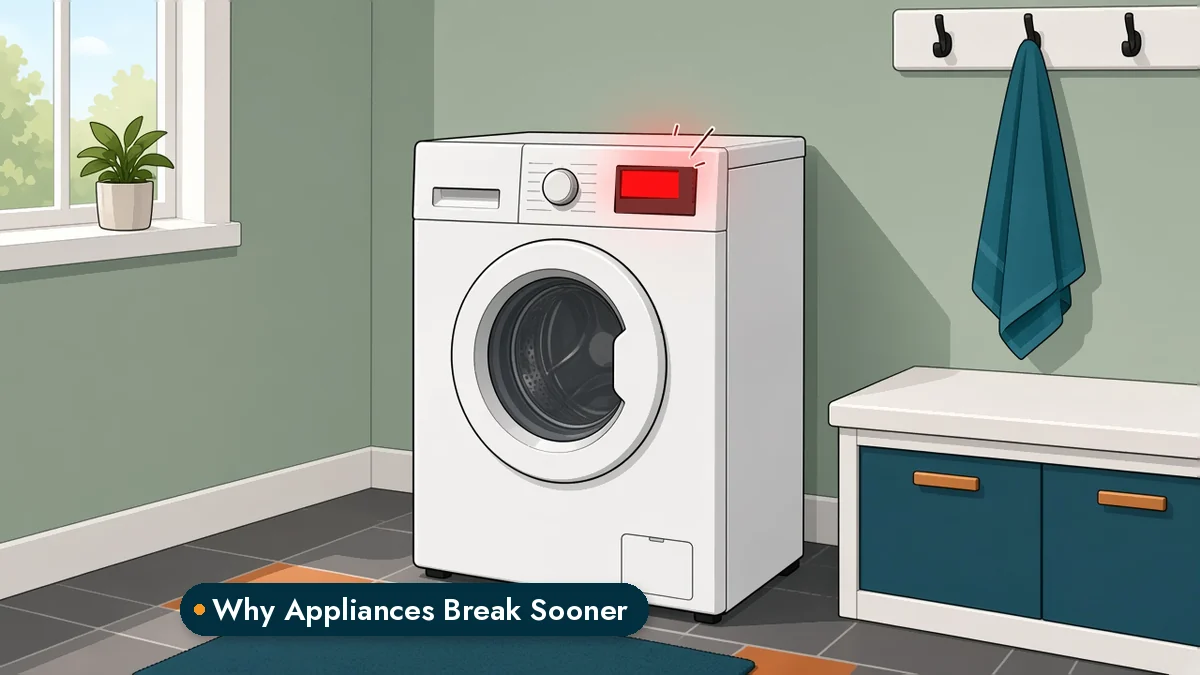
- A dead or blank display, or buttons that stop responding
- A cycle that stops partway through, or a machine that ignores the setting you picked
- A part that runs when it shouldn't, like a pump that never stops or a fan that never starts
- Problems that come and go, often after a storm or a power flicker
An error code tells a technician which system reported a problem, not always which part failed. A drain error can come from a clogged pump, a failed pump or the board that powers the pump. That is why a good diagnosis tests the parts around the board before blaming the board itself. Makers sometimes issue service bulletins about fault codes that point somewhere you wouldn't expect, and technicians report that this kind of information is often hard to get (PIRG).
Power surges can damage a control board, either all at once or slowly over time. Our guide to habits that lead to early appliance failures covers surges and other common causes.
Why can a control board cost more than a mechanical part?
A belt, a door switch or a heating element is a simple part, and the same one often fits many models. A control board is different:
- It is often made for one model or a small group of models. Fewer are made and fewer are kept in stock.
- It is replaced as a whole unit. Fixing the board itself means finding one failed component on it. Repair manuals often leave out the details needed for that kind of repair, which leaves swapping larger, more expensive parts (PIRG).
- Some boards need setting up after they go in. Certain models need the new board matched to the exact model, and every board repair should be tested through a full cycle.
So a board repair usually costs more than replacing a worn belt or a sticking switch. It can still be well worth doing on a newer appliance that is otherwise in good shape.
Do energy-efficient appliances fail more often?
Not by themselves. To save water and power, newer machines rely on more precise parts. Washers that earn the ENERGY STAR use efficient motors that spin clothes two to three times faster to pull out more water, and dryers that earn it use sensor drying that ends the cycle once clothes are dry (ENERGY STAR laundry fact sheet). A washer motor that tumbles slowly and then spins fast needs an electronic control to change its speed, and the sensors report to the board all through the cycle. Each of those is one more part that can fail and needs proper testing.
Even so, the technicians in the Environment America survey ranked efficiency standards among the least likely reasons for shorter lifespans (Environment America). Materials, electronics and access to repair mattered far more to them.
Why do parts take longer to get?
- Model-specific parts aren't always on the shelf. Boards and sensors made for one model often have to be ordered, and the repair waits until the part arrives.
- Parts access is a known problem in the trade. In a 2023 investigation by PIRG, iFixit and the Repair Association, all but one of the technicians surveyed said they at least occasionally have trouble getting parts (iFixit).
- Older models can run out of parts. Once a board is discontinued, finding one gets harder.
Before you approve a repair, ask whether the part is in stock and how long it should take to arrive. Before you buy a new appliance, it's worth asking how long the brand supplies parts for that model.
What did Canada's 2024 right-to-repair change do?
Bill C-244 amended the federal Copyright Act and received royal assent on November 7, 2024 (LEGISinfo, Parliament of Canada). It lets a person, including a repairer working for you, get around a software lock (the law calls it a technological protection measure) when the only purpose is to diagnose, maintain or repair a product (Copyright Act, section 41.121). Lawyers describe it as a limited exception to the digital-lock rules (Torys LLP).
What it does not do matters just as much. It is a repair exception, not a supply rule: nothing in it requires manufacturers to supply parts, manuals or diagnostic tools (Copyright Act, section 41.121). So parts availability is still worth checking before you buy.
Where the electronics show up in each appliance
Washers
A newer washer's board manages water level, temperature and spin speed. Other common faults are a failed drain pump, a faulty door lock, leaks and heavy shaking on spin. If your washer keeps draining slowly or shaking, our washing machine repair team can find the cause.
Fridges
Temperature sensors tell the board when to run the compressor, the fans and the defrost cycle. Some newer fridges use a variable-speed compressor with its own control board. Other common faults are failed sensors, defrost problems, worn door seals and compressor trouble. If your fridge isn't holding its temperature, book a fridge repair visit before food spoils.
Dishwashers
Dishwashers now offer more cycles and water-saving settings, all run by a board and a touch or button panel. Other common faults are drain problems, heating problems, leaky seals and blocked spray arms. Cleaning the filter regularly helps. If it still won't drain or dry, our dishwasher repair technicians can check the pump, the heater and the board.
Dryers
Dryers heat up and spin for long stretches, which wears parts. Common faults are a faulty heating element (electric) or igniter (gas), a worn belt, a blown thermal fuse, a blocked vent and dirty moisture sensors. Clearing the lint screen every load helps airflow. If your dryer runs but won't heat, see our dryer repair service.
Simple care that protects newer appliances
- Don't overload. Follow the capacity guide for your washer and dryer to ease the strain on motors and bearings.
- Clean filters and lint screens on schedule. Clean any fridge coils you can reach, too.
- Use the right detergent. Use a high-efficiency detergent in a high-efficiency washer, and don't use more than the label says.
- Think about surge protection. An electrician can tell you whether whole-home surge protection makes sense for your panel.
- Call early. New noises, leaks or an error code that keeps coming back are easier to fix before they spread to other parts.
For more habits that shorten appliance life, see our guide to how improper use leads to early failures.
When does a repair still make sense?
When one part has failed on a newer appliance and that part is available, a repair is often the better value. For the full decision, read our repair-or-replace guide, and for typical lifespans see how long a refrigerator lasts in Canada.
We serve Bradford, Barrie, Newmarket and nearby Central Ontario communities. See typical repair costs before you call.
Not sure if it's worth fixing?
Book a diagnostic. Our $99 promotional diagnostic (regular $129) is waived if we do the repair. Repairs come with a 90-day warranty on parts and labour, and same-day service is available. Call 1-855-448-0096 or book online.
FAQ
Why are modern appliances breaking sooner?
Newer appliances run on more control boards, sensors and displays, so there are more parts that can fail. Technicians also point to less durable materials and to limits on parts, manuals and software that make repairs harder.
How long should modern household appliances last?
It depends on the type, the model and how it is used and cared for. As one example, a fridge in Canada usually lasts about 10 to 18 years depending on its style; our guide on how long a refrigerator lasts in Canada breaks down the ranges.
Are modern appliances more expensive to repair?
Sometimes. A failed control board is usually replaced as a whole unit and is often made for one model, so it tends to cost more than a mechanical part like a belt or a switch. Parts that have to be ordered can also add wait time.
Should I repair my appliance if it is under 5 years old?
Often, yes. At that age the problem is usually one failed part, not general wear. Check whether the manufacturer's warranty still covers it first, then get a diagnosis so you know the real cost before you decide.
Does Canada have a right-to-repair law for appliances?
Yes, in part. Since a 2024 amendment (Bill C-244, royal assent November 7, 2024), the federal Copyright Act lets you or a repairer get around a software lock to diagnose, maintain or repair a product. It does not require manufacturers to supply parts, so check parts availability before you buy.
How can I make my modern appliances last longer?
Don't overload the washer or dryer, clean filters and lint screens on schedule, clean the fridge coils you can reach and use the right detergent. Call early when you notice new noises, leaks or repeat error codes.
Questions about a newer appliance? Our technicians can help. Call 1-855-448-0096 or book online.